Regulatory change execution – how do you rate? How Financial Services Firms Can Benchmark Their Regulatory Change Management Maturity
Somewhere right now, a compliance team at a financial services firm is staring at a stack of regulatory updates — new guidance from one agency, a rule amendment from another, a consultation paper from a third — and asking the same questions they asked last week, and the week before: What actually changed? Does this apply to us? And what do we need to do about it?
If that sounds familiar, you’re not alone. Regulatory change management is one of the most operationally demanding disciplines in risk and compliance — and for most firms, it’s getting harder, not easier.
The Problem Isn’t Awareness. It’s Execution.
The volume of regulatory change facing financial services firms today is staggering. Across banking, asset management, insurance, and most especially, new fintechs offering crypto, buy now/pay later, and payments offerings, firms must continuously track rule changes, guidance updates, and new obligations from dozens — sometimes hundreds — of supervisory agencies across multiple jurisdictions. The more products you offer and the more markets you operate in, the more complex that challenge becomes.
Most firms have taken some steps to address this. Many have invested in horizon scanning tools or regulatory intelligence feeds that surface relevant documents and alerts. That’s a necessary starting point, but here’s the reality: monitoring regulations and identifying that a change has occurred is the table stakes. It’s speed of execution that determines whether your firm is effectively managing regulatory change — or just grinding for weeks to turn raw information into actionable intelligence.
Understanding what changed, determining whether it impacts your business, making the right decisions, and taking timely action — that’s where firms win or lose on regulatory change. And that’s exactly where most current approaches break down.
Where Most Firms Get Stuck
Despite good intentions and real investment, a large number of financial services firms still fall into one of three patterns:
The Manual Tracker. Regulatory changes are logged in spreadsheets, distributed via email, and managed through a combination of tribal knowledge and individual heroics. It works — until someone leaves, volumes spike, or an examiner asks for an audit trail.
The Document Collector. The firm has invested in horizon scanning technology that surfaces regulatory documents and sends alerts when something is published. But the answers to the critical questions – most notably the regulatory obligations – are still buried in those documents. Someone still has to read everything, interpret it, assess applicability, and determine what action is required. The tool reduced noise; it didn’t reduce work.
The Partial Automator. Workflow tools are in place, and some steps are more structured. But there are still significant gaps — particularly around intelligent interpretation, automated impact assessment, and seamless connectivity to the GRC systems, policies, and controls that ultimately need to reflect the change.
The common thread across all three? Too much time is spent getting to an answer, and not enough time acting on it.
What a Mature Capability Actually Looks Like
Firms that have built genuinely effective regulatory change management capabilities share a few defining characteristics. They don’t just know that a regulation changed — they know what changed, at the obligation level, and they can immediately see whether it’s relevant to their specific entities, products, and business lines.
Their obligations aren’t buried in documents. They’re maintained in a structured, dynamic digital library that updates automatically when rules change, preserves prior versions for reference, and connects directly to the policies and controls that need to stay aligned.
Their teams aren’t spending days reading websites and cross-referencing rule text. They’re spending their time on higher-value decisions — reviewing automated impact assessments, assigning and tracking remediation tasks, and closing out changes with a clear, auditable record of how each one was handled.
Perhaps most importantly, when a regulator asks how the firm manages regulatory change, they can answer with confidence — and back it up with data.
That’s the difference between a firm that monitors regulatory change and one that manages it.
How Do You Know Where You Stand?
The gap between where firms are today and where they need to be isn’t always obvious from the inside. Processes that feel manageable in calm periods can become brittle under pressure. Capabilities that seemed sufficient last year may not hold up as regulatory volumes increase or your business expands into new jurisdictions.
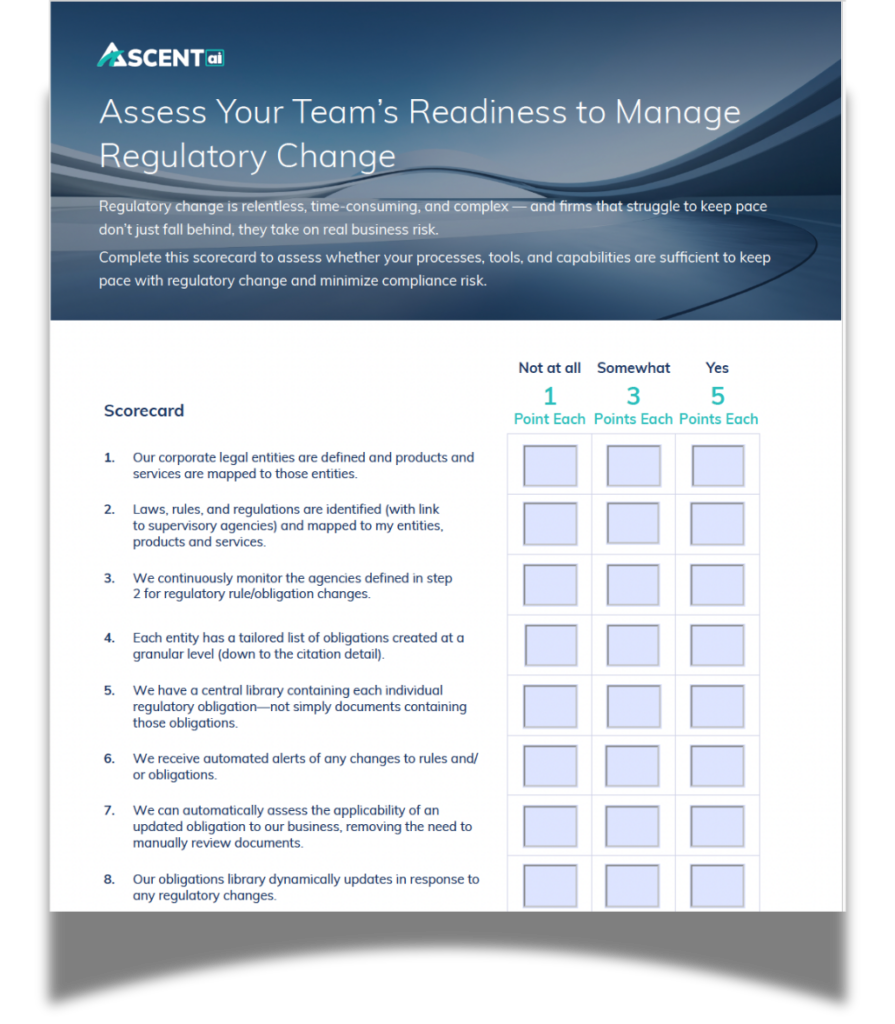
That’s exactly why we built the Regulatory Change Management Readiness Scorecard — a quick, structured self-assessment designed to give compliance and risk professionals an honest picture of their current capabilities.
The scorecard walks through 14 capability statements across the full regulatory change management lifecycle — from entity and obligation mapping, to monitoring and alerting, to impact assessment, workflow, and GRC integration. The assessment takes about five minutes. The insights can inform your next year’s compliance technology roadmap.
Take the Regulatory Change Management Readiness Assessment
Check out our regulatory change management scorecard and see how you rate.
What Comes Next
Your scorecard results will highlight not just your overall maturity rating, but the specific capability dimensions where your firm is strong — and where targeted improvements would have the greatest impact on risk reduction and operational efficiency.
For firms earlier in their maturity journey, the results often reveal that the biggest gains come not from doing more, but from working smarter — replacing manual interpretation with automated analysis, replacing document repositories with structured obligation libraries, and replacing email chains with auditable workflow.
For firms already performing well, the scorecard often surfaces the final integration gaps — particularly around GRC connectivity — that separate a good process from a truly resilient one.
AscentAI’s regulatory change management platform is purpose-built to address each of these capability dimensions. If you’d like to walk through your results and explore how AscentAI can help close the gaps, we’d welcome the conversation.
Regulatory change isn’t slowing down. The firms that pull ahead are the ones that stop just tracking it — and start executing on it.
Contact AscentAI to learn more about automating regulatory change management for optimum efficiency, cost savings, and risk mitigation.