As crypto goes more mainstream, the currency’s regulatory ‘free ride’ is coming to an end. PYMTS magazine recently reported on new crypto regulatory requirements for 2026:
… a Jan. 1 report reveals that tax authorities around the world are closing in on crypto tax evasion by requiring exchanges to start collecting and reporting detailed trading records for local customers in the U.K. and more than 40 other countries.
The tax news in particular is less about revenue collection than it is about legitimacy. An asset class that cannot be reliably taxed cannot be fully integrated into national economies. By forcing exchanges to shoulder reporting responsibilities, governments are shifting cryptocurrency from a self-policed ecosystem to one embedded in public financial infrastructure.
In a strange way, however, crypto is lucky when it comes to regulatory compliance. Unlike legacy institutions saddled with years or decades of patchwork and/or manual compliance processes, crypto firms can start from scratch. Out of the gate, they can exploit the exciting new automation technologies that maximize efficiencies while minimizing both costs and risk. They can develop a single source of regulatory truth for the entire firm—a one-stop shop for all compliance-related information, from new regulations that apply to the firm, to specific regulatory obligations, to assigned compliance tasks.
Horizon scanning tools will be particularly valuable to crypto firms. These tools scan the international regulatory landscape to identify new regulations, regulatory trends, and regulatory information such as guidance and news. The latter will be particularly important to crypto firms. With new regulations coming into play, information like regulator guidance will keep you abreast of regulatory areas of emphasis and the interpretation of new rules, minimizing the growing risk of running afoul of regulators.
[In 2025] The U.S. Securities and Exchange Commission (SEC), for example, brought more than 30 crypto-related enforcement actions, resulting in $2.6 billion in penalties and restitution—the highest total ever for the sector.
It’s important that firms choose a tool that isolates only relevant information. Otherwise, you’ll waste time wading through mountains irrelevant compliance communications to find those that apply to your business, increasing the risk of misidentifying or missing relevant data.
Regulatory change is another area on which the crypto industry should focus as they adjust to regulatory scrutiny. The volume and velocity of regulatory change have increased in recent years and show no sign of slowing. Keeping up with new and updated rules is a serious challenge for the largest and most mature banks. It will be no less a challenge for crypto firms.
Ensure you enlist tools that help refine and structure your regulatory change management processes. AscenAI’s AscentFocus provides an AI-powered Change Management Dashboard that displays all applicable new and updated rules while providing links to side-by-side comparison of the old versus the new rule, with changes highlighted. The Dashboard also provides links to the full regulation, along with summaries of the changes to your specific obligations—the actions you must take to remain compliant—and links to the updated obligation text. You’ll immediately have the information you need to identify new and updated regulations relevant to your business as well as identify if and how a rule change impacts your specific regulatory obligations.
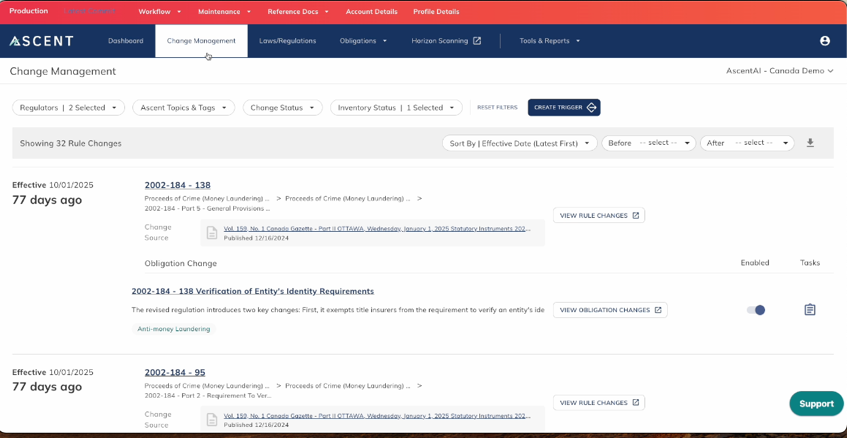
From the same dashboard, AscentFocus lets you manage compliance-based tasks, ensuring that the right people have the right information in a timely manner to ensure you’re always working from up-to-date compliance information.
For crypto firms, the operational implications of the growing compliance-first pivot are significant. Compliance teams must scale. Data systems must mature. Jurisdictional differences must be navigated with care. The cost of doing business will rise, particularly for smaller players.
As crypto firms enter the world of financial regulatory compliance, it’s critical to get it right and not repeat the mistakes of legacy institutions. It is impossible to keep up with the volume and velocity of international regulatory change with spreadsheets and manual, disjointed processes. Automation and AI tools have transformed the compliance landscape, and crypto firms can gain their savings and efficiencies from the jump, dramatically improving their risk profile, while embedding both scalability and cost-effectiveness.
Learn more about adopting AI-fueled automation tools for an efficient, state-of-the-art compliance profile. Or, if you have any questions on how AscentAI can equip risk and compliance with AI-powered tools to manage the rapidly emerging crypto space, please let us know and we’d be happy to answer them.