
It’s particularly dangerous for financial institutions to rely on “federal only” regulatory coverage. Not only do states have their own regulatory agendas, but the current administration’s de-regulatory bent has prompted states to step up with financial services regulations to plug what they see as holes in federal regulatory net.
That’s why relying on tools that track and monitor “US regulations” can create a dangerously incomplete picture. The commercial cost is not only regulatory risk; it can also mean delayed launches, incorrect licensing assumptions, and duplicated legal research.
Areas where state-level regulation is particularly important include money transmission, lending, insurance, consumer finance, and digital assets. The latter is a classic example of federal regulatory retreat followed by state action. The Department of Justice (DOJ) disbanded the National Cryptocurrency Enforcement Team and the DOJ announced that it will no longer “pursue litigation or enforcement actions that have the effect of superimposing regulatory frameworks on digital assets.”1
Conversely, in New York, the Attorney General has filed suit against crypto firms buying and selling tokens without registering with the state, and in Iowa, crypto firms have run afoul of the state’s Consumer Fraud Act. Take this as further proof that the shifting of federal enforcement priorities do not remove exposure — firms still need to manage independent state licensing, regulatory, and enforcement requirements.
Check out the interactive spreadsheet of state consumer finance laws from the Conference of State Bank Supervisors.
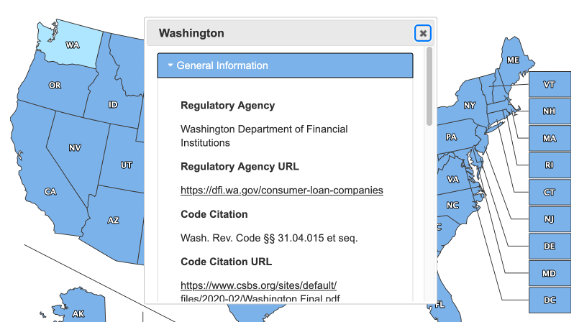
Money transmission is another area where the variation is state laws can be dizzying. While the Money Transmission Modernization Act (MTMA)—a single set of nationwide standards—was approved for state adoption, only thirty-one states have adopted the law in full or in part. More importantly, the Conference of State Bank Supervisors (CSBS) noted that uneven adoption and interpretations have resulted in variations in implementation.
In consumer finance, you contend with state licensing laws for financial services organizations, state lending laws, interest rate limitations, and unfair, deceptive, or abusive acts or practices (UDAAP/UDAP) statutes on the state level, plus related consumer protection regimes. In addition, the Consumer Financial Protection Act of 2010 (CFPA) enables states to enforce federal consumer protection laws that fall under it. These are state-level rules and guidance that multi-jurisdictional organizations cannot afford to ignore.
When someone discusses “US regulatory coverage,” make sure that this term includes state-level regulators, regulations, and guidance. If it does not, you dramatically elevate risk and open the door to potentially multiple instances of non-compliance.
When considering compliance automation tools, it’s critical to ask:
- If “US coverage” includes all 50 states
- Which document and issuing-body types are covered
- If coverage comprehensive or added only when requested
- Are obligations extracted consistently across states
- How state adoptions and variations are maintained
AscentAI provides comprehensive 50-state coverage, automating identification of state-level obligations, and segregating contextual items like guidance and news from the obligations that tell you what you need to do to stay compliant.